

I’ve spent twenty years working with sales teams, and I’ve watched the same movie play out for the last three.
A CEO calls me, convinced AI is about to solve their growth problem. They’re right about one thing. AI genuinely changes the game for anyone who knows how to structure their sales team before turning it on. But nine times out of ten, that’s not what happens. The tool gets bolted onto a process that never existed, and everyone wonders why nothing changed.
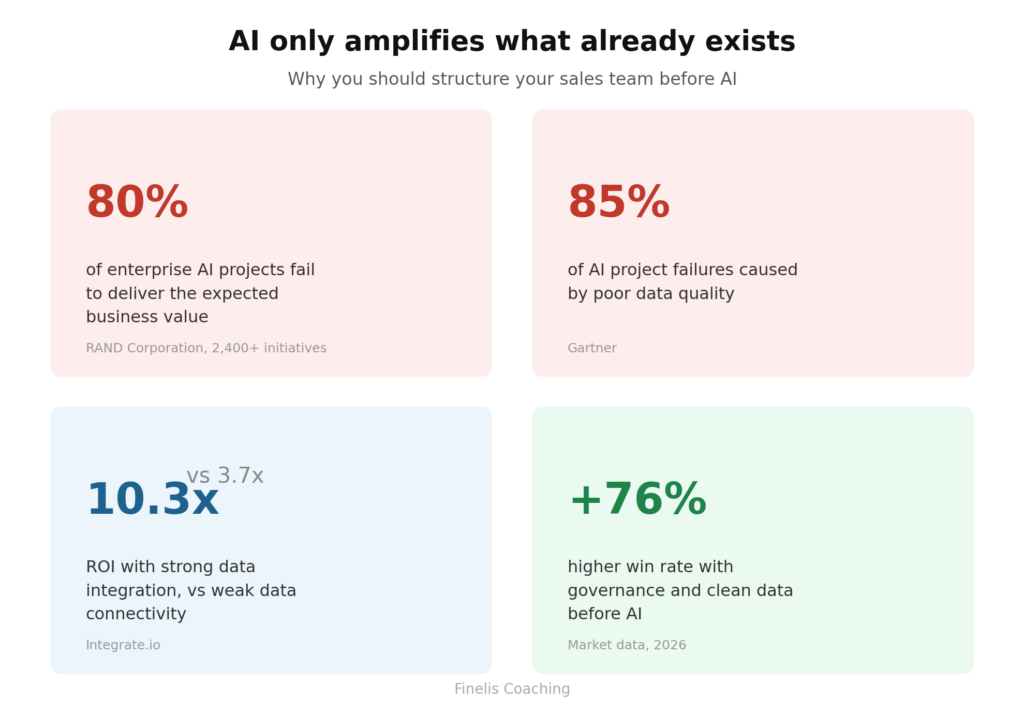
Here’s a number worth sitting with before your next subscription signature. 80% of enterprise AI projects fail to deliver the business value expected. That comes from a RAND Corporation analysis of more than 2,400 initiatives. And the cause is almost never the tool itself.
Table of Contents
Why AI amplifies your weaknesses before it fixes them

Here’s what I tell every CEO I work with. AI isn’t a fix. It’s an amplifier. It doesn’t repair anything on its own. It takes whatever already exists in your organization, and runs it faster, at greater scale. Most leaders find this counterintuitive at first, because the marketing around AI sales tools promises the opposite: instant improvement, regardless of what came before.
When a team has a fuzzy qualification process, AI doesn’t clarify it. It simply generates more poorly qualified leads, faster. When customer data is messy or incomplete, AI doesn’t clean it up on its own. It produces recommendations built on noise, with the same confidence it would show if the data were perfect. That’s actually worse than before. The mistake moves faster, and it inspires trust because it came from an algorithm.
Gartner has measured this precisely. 85% of AI project failures come down to poor data quality or a lack of relevant data. That’s not a model problem. It’s a foundation problem.
And the performance gap between the two approaches is far from marginal. Research from Integrate.io found that companies with strong data integration reach a 10.3x ROI. Those with weak data connectivity cap out at 3.7x. Nearly three times the difference. That’s not a nuance. That’s a different category entirely.
I regularly see two companies investing in the same AI tools, with opposite results:
| Company adding AI without structure | Company structuring before AI | |
|---|---|---|
|
Database |
Duplicate contacts, outdated information, no qualification criteria |
Clean reference set, defined ICP, verified criteria |
|
What AI does |
Generates volume from bad signals |
Amplifies already-precise targeting |
|
6-month outcome |
More leads, same mediocre conversion rates |
Shorter sales cycle, rising win rate |
|
Team perception |
“The tool doesn’t work” |
“We’re finally selling faster” |
The difference between these two companies is never the quality of the tool they bought. It’s what they had already built before switching it on.
I think back to one specific case, no names attached. A fintech company had invested a generous budget in an AI lead scoring tool. Three months later, the CEO called me, frustrated. His reps were getting scores but ignoring them, still working off gut instinct. Digging in, the reason became obvious fast. The CRM was full of duplicates, statuses nobody updated, and three different definitions of a “qualified lead” depending on which rep you asked. The AI had done exactly its job. It scored whatever it was given. The problem was never the algorithm. It was the data fed into it, and the missing shared definition upstream.
What I see over and over in coaching sessions: the leaders who get a real return on AI are the ones willing to run the uncomfortable audit of their process before adding the technology layer. [Book a strategic coaching session] if you want to run that audit together.
The foundations to secure before any AI sales rollout

Before you thank me for scaring you, here’s the good news. These foundations don’t require a huge budget, or six months of work. Mostly, they require discipline, and the right order. Here’s what to secure first:
- 1. A shared qualification framework. Before letting an AI score your leads, your human team needs to already agree on what a good prospect looks like. If three reps give you three different definitions of a qualified lead, no algorithm can settle that for them.
- 2. A prospecting sequence designed across the full cycle. AI excels at automating repetitive tasks. But automating a poorly designed sequence just sends the wrong message faster. The logic of the sequence has to exist before the automation, not after.
- 3. Metrics tracked over time, not just monthly revenue. Without stage conversion rates and average cycle length, you’ll never know whether AI is genuinely improving your results, or simply hiding a deeper problem behind more activity.
- 4. A clean, properly enriched database. This is the least glamorous part, and the most often skipped. Yet it’s the one that determines whether AI amplifies your strength or your confusion.
- 5. A clear definition of what “success” means. Most AI projects fail because nobody defined, in advance, what would count as a win. Without that definition, there’s no way to know if the tool is working, or if you’re just telling yourself a story.
Three questions to ask yourself before your next AI investment:
- Does my team already use a written, shared qualification method, without any AI involved?
- If I had to show an investor my CRM database today, would I be proud of it, or slightly embarrassed?
- Have I written down what measurable success would look like six months after adding AI to my sales process?
If you’re hesitating on any of these three, what you need this week isn’t an AI tool purchase. It’s an audit.
Structure first, scale second: the method

Here’s how I actually run this with the teams I work with, in order, no shortcuts.
Step 1: map the real process, not the assumed one. I always ask teams to reconstruct their last twenty closed deals, step by step. What actually happened, not what people think happened. This is usually where the gap between theory and practice becomes impossible to ignore. A CEO who thought they had a tight process sometimes discovers, right here, that every rep has been improvising their own version for months.
Step 2: formalize a shared framework before touching any tool. Pipeline stages, qualification criteria, shared definitions. This step costs nothing in tools. It costs in collective discipline, and it’s often the hardest part emotionally, because it forces everyone to give up their personal method in favor of a common system. I’ve watched senior reps resist this step harder than junior ones, simply because they’ve built years of habits around their own way of doing things.
Step 3: clean and structure the data. This is the least exciting work, and the most decisive. Clean data turns an average AI into a powerful tool. Dirty data turns the best AI on the market into a false-positive generator.
Step 4: introduce AI on a narrow scope, with a measurable goal. Not across the entire sales cycle at once. One precise entry point, one success metric defined in advance, a review at 90 days.
Step 5: measure, adjust, and only expand if the numbers confirm it. Companies that build governance and clean data into their AI rollout report win rates 76% higher, according to market data. AI itself doesn’t produce that result. AI applied to an already solid foundation does.
This method takes patience, I won’t lie to you about that. But it avoids the scenario I see far too often. Six months of an expensive AI subscription. A frustrated team. A leader wrongly concluding that “AI just doesn’t work for our industry.” The AI was working fine. The foundation was missing.
The pattern repeats itself often enough that I can usually predict it within the first ten minutes of a call. A founder describes underwhelming results from a tool that, on paper, has an excellent reputation. A quick look at their CRM tells the real story: no shared definitions, stale records, no agreed criteria for what counts as progress. The technology gets blamed for a structural problem it never had the power to fix.
One last piece of advice, and it might be the most important one. Never let introducing AI become an excuse to avoid the structuring work. I’ve seen teams buy an AI tool precisely because building a real process felt too slow and too tedious. That’s the reverse of the right sequence, and it guarantees paying twice. Once for the tool, and once for the structuring work you’ll have to do anyway, six months later, once the disappointment sets in.
The bottom line
AI never saves a poorly structured sales process. It exposes its cracks, faster and at greater scale than any human could do alone. Companies that get a genuine return on their AI investments share one thing in common. They agreed to do the invisible work first: a shared qualification framework, a sequence designed across the full cycle, clean data, a clear definition of success.
The question worth asking isn’t “which AI tool should I buy this year.” It’s: “what do I need to structure in my team before AI has something solid to amplify?”
Want an outside perspective on where your sales team actually stands?
That's exactly the work I do with the fintech leaders I coach at Finelis Coaching. Book a diagnostic session and let's look, without filters, at what's ready for AI and what isn't yet.