
A few months ago, I watched a promising fintech deal die in real time, and it taught me more about human-first sales than any strategy deck ever has. The product was excellent. The pricing was fair. The AI-powered outreach sequence had done everything right: perfect timing, flawless personalization, an impressively “human” tone.
And still, the deal died.
The product wasn’t the problem. The buyer, a compliance director at a mid-sized bank, never once felt like she was talking to someone who understood her world. She was being processed, efficiently, politely, and precisely. So she walked.
I have spent years inside sales cycles for fintech, regtech, and complex software companies selling into regulated, skeptical markets. And if there’s one lesson 2026 keeps confirming, it’s this: the more automated selling becomes, the more decisive human-first sales moments get, not less.
If you’re a founder or sales leader betting your growth on AI doing the heavy lifting alone, this article might change how you think about your next twelve months.
The New Reality: Your Buyers Have Never Been More Guarded
Let’s name what’s actually happening. Buyers today are drowning in automated outreach. Every inbox is a warzone of AI-generated pitches that all sound eerily similar. Consequently, their default instinct is no longer curiosity, it’s suspicion. The moment something feels templated, credibility drops instantly.
Tip 1: If your outreach could be sent to ten different prospects without changing a single sentence, it will be read like it was, and ignored like it was.

Layer on regulation, and the picture gets more complicated still. European buyers in fintech, regtech, and embedded finance are more cautious, more procedural, and answerable to more stakeholders than ever before. A single deal might pass through compliance, a technical evaluator, procurement, and a board that needs convincing. Each one filters your pitch through a different fear, and none of them are moved by a well-timed follow-up email.
So here’s the uncomfortable math: more automation in the market means more noise. More noise means buyers trust less. And when trust drops, deals don’t slow down gently, they stall, ghost, or vanish entirely.
Why Human-First Selling Is Becoming the Real Competitive Edge
Here’s what rarely gets said out loud: when everyone has the same AI tools, AI stops being the advantage. It becomes table stakes. The real differentiator moves somewhere AI genuinely cannot follow, into how deeply your team understands the client’s actual problem.
Consider how a typical buying cycle unfolds in a regulated sector. AI can find the right accounts. It can draft the first message. It can even flag intent signals with impressive accuracy. Eventually, though, the prospect asks a version of the same question: can I trust these people with something this important?
No algorithm answers that convincingly. Only a person can.
Tip 2: Trust isn’t built in the pitch. It’s built in the pause, the moment your team says “I don’t know, let me find out,” instead of bluffing a confident-sounding answer. Buyers remember honesty far longer than polish.
This is why a human-first sales approach isn’t a nostalgic throwback. It’s arguably the sharpest strategic move available in a market this saturated with automation. AI should do the finding. People should do the convincing.
What Human-First Sales Actually Looks Like in Practice
Most articles stay vague at this point, so let’s not. This is what separates teams that talk about trust from teams that actually earn it:
The best reps I’ve trained ask three real questions before mentioning the product once, unlike a bot, which pitches in message one.
Not a merge tag. Sector, regulation, language, actual context, never “Hi {FirstName}, noticed you’re in {Industry}.”
Regulated buyers move slowly by design. Rushing them doesn’t accelerate the deal, it signals you don’t understand their world, which quietly kills it.
A pitch that lands in London can fall flat in Madrid, not because of language, but because of what “trust” sounds like locally.
One robotic follow-up can undo three months of carefully built credibility. Just one.
Tip 3: Track how many touchpoints it takes before a prospect stops replying with one-word answers and starts asking real questions. That shift, not open rates, is your true trust signal.
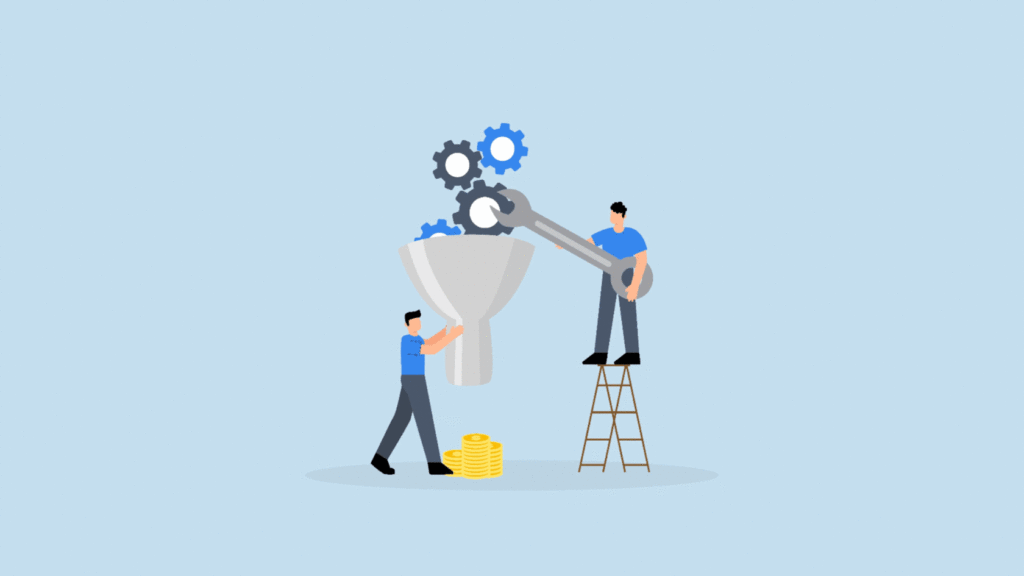
None of this rejects AI, quite the opposite. The founders winning right now use AI exactly where it’s brilliant (research, prioritization, drafting) and protect human bandwidth for exactly where it’s irreplaceable: judgment, empathy, and the conversation that actually closes.
There’s a trap worth naming here too. Founders often mistake pipeline volume for progress: more leads, more outreach, more activity. Yet conversion stays flat, because volume was never the real bottleneck. Credibility was. And unlike outreach volume, credibility can’t be automated at scale. It has to be earned, deliberately, by people.
The Bottom Line
Agentic AI isn’t the enemy here. It’s a genuine gift for efficiency, and ignoring it would be foolish. But the shift worth sitting with is this: the more AI accelerates the sales process, the more valuable, and rarer, real human trust becomes.
Founders who understand this in 2026 won’t just close more deals. They’ll close the hard ones, the complex, regulated, high-stakes deals that automation alone will never touch.
The question isn’t whether AI will change how you sell. It already has. The real question is whether your buyers will trust what’s left once the automation stops talking, and a human finally does.
How Finelis Builds Human-First Sales as a Service
This is exactly the gap Finelis exists to close. Instead of asking founders to build, hire, and train a full internal sales team from zero, we deliver human-first sales execution as a service, combining smart process with genuinely human, multilingual expertise across French, Spanish, and UK markets.
We don’t simply translate messaging, we adapt how trust itself is communicated. A French compliance officer, a Spanish operations lead, and a British procurement director aren’t moved by the same tone, pace, or argument. Recognizing that difference, and adjusting for it instinctively, is what separates a real sales function from a generic one.
Because our model scales as a service rather than fixed headcount, you also gain sales capacity that flexes with your growth stage, without the six-month ramp-up or the risk of a bad internal hire during a critical funding window.
Curious what that could look like for your pipeline?
Let's talk, no pitch, just a real conversation about where trust is currently costing you deals.
Contact us